
NPO Evidence Dashboard 2028–33
Back up every answer in your National Portfolio application with data.
The Arts Council England National Portfolio 2028–33 application asks you to prove your case in writing. You can't add charts, and every answer has a strict character limit. Most organisations already have the evidence. The hard part is knowing which figures prove which point, and getting them into a strong answer before the deadline.
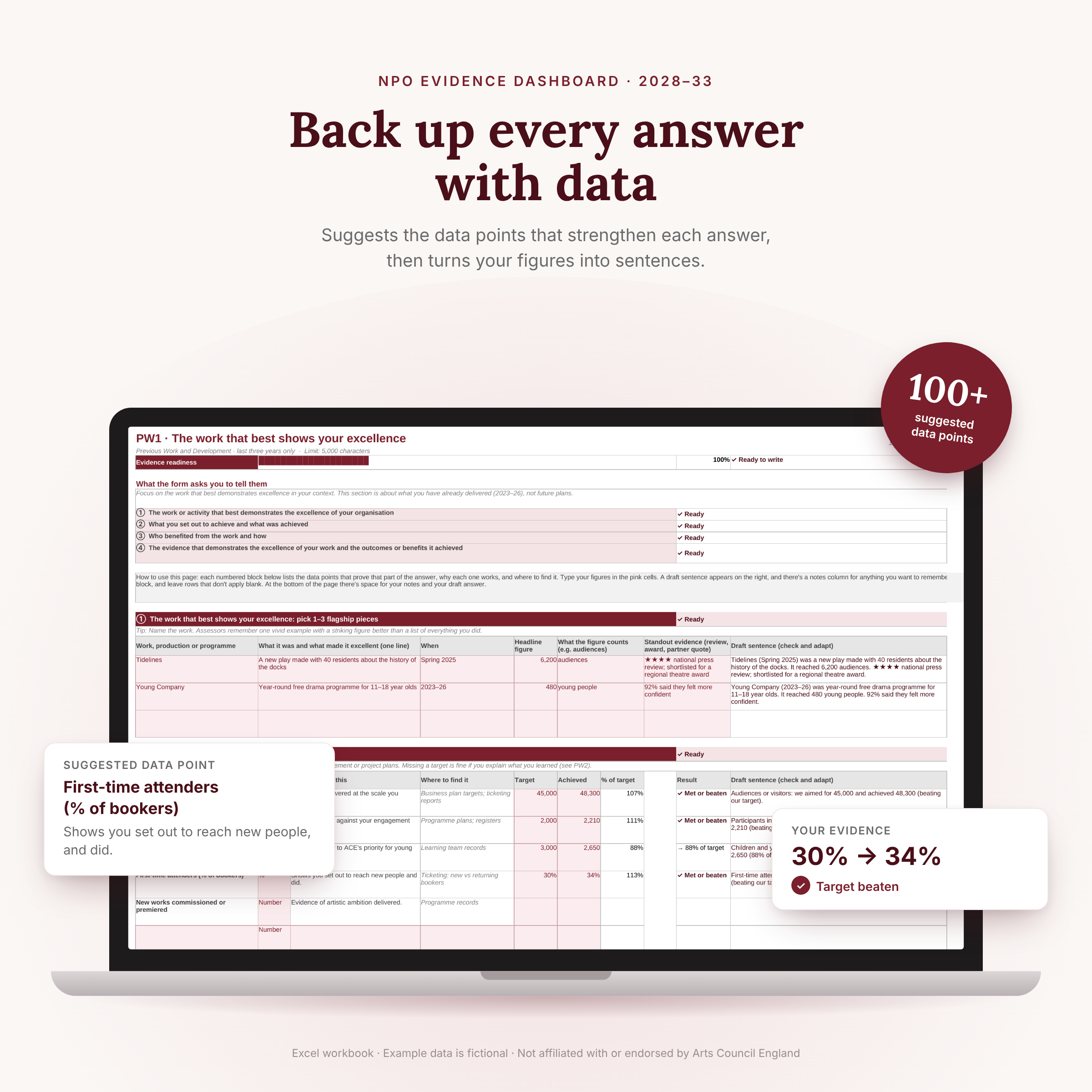
This Excel workbook goes through the application one question at a time. It suggests the data points that strengthen each answer, explains why each one works and where to find it, then turns your figures into sentences you can use.
How it works
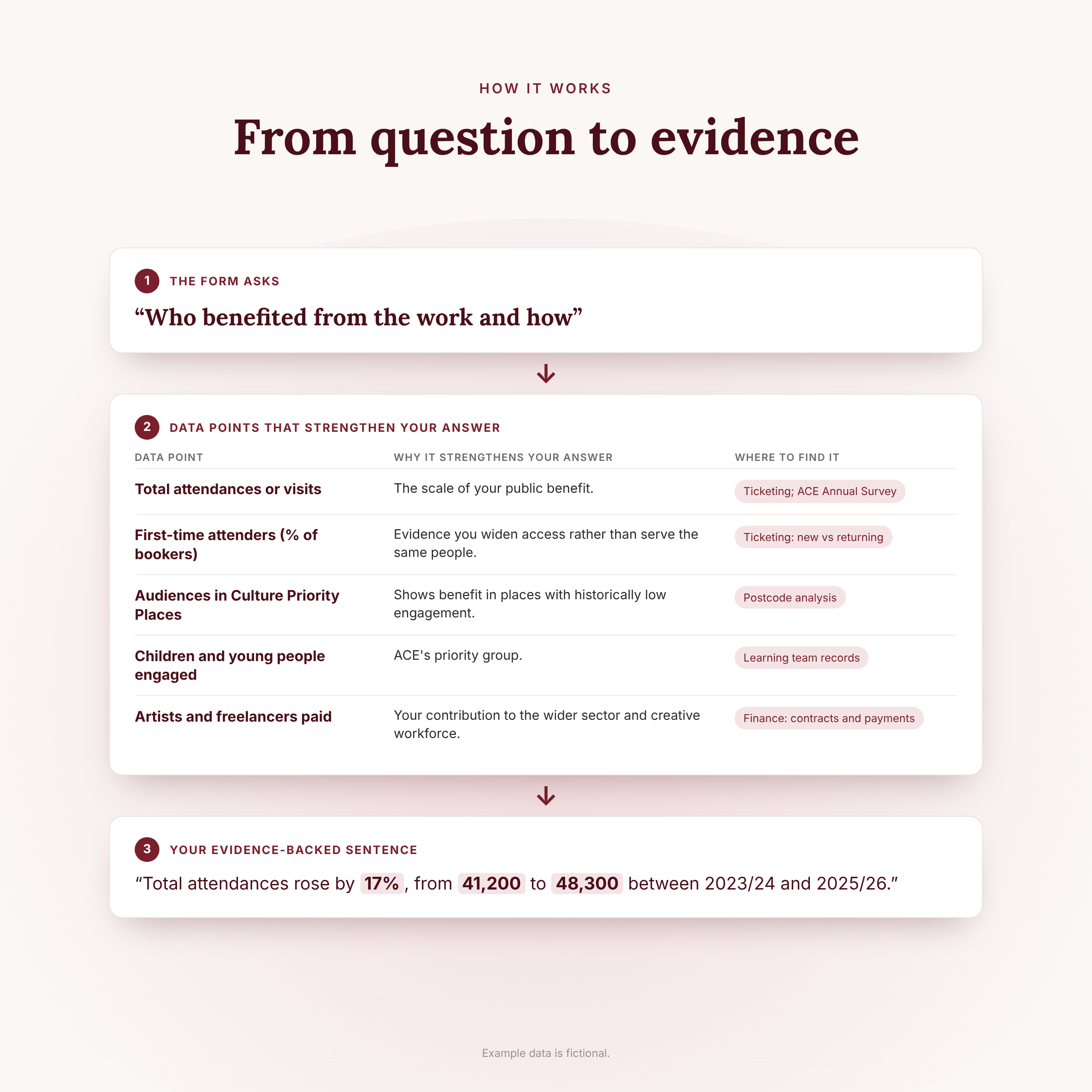
Pick a question. Each page starts with exactly what the form asks, split into numbered points.
Add your figures. Under each point you'll find the data that makes the strongest case, why it works, and where to find it: ticketing, finance, surveys or free public data.
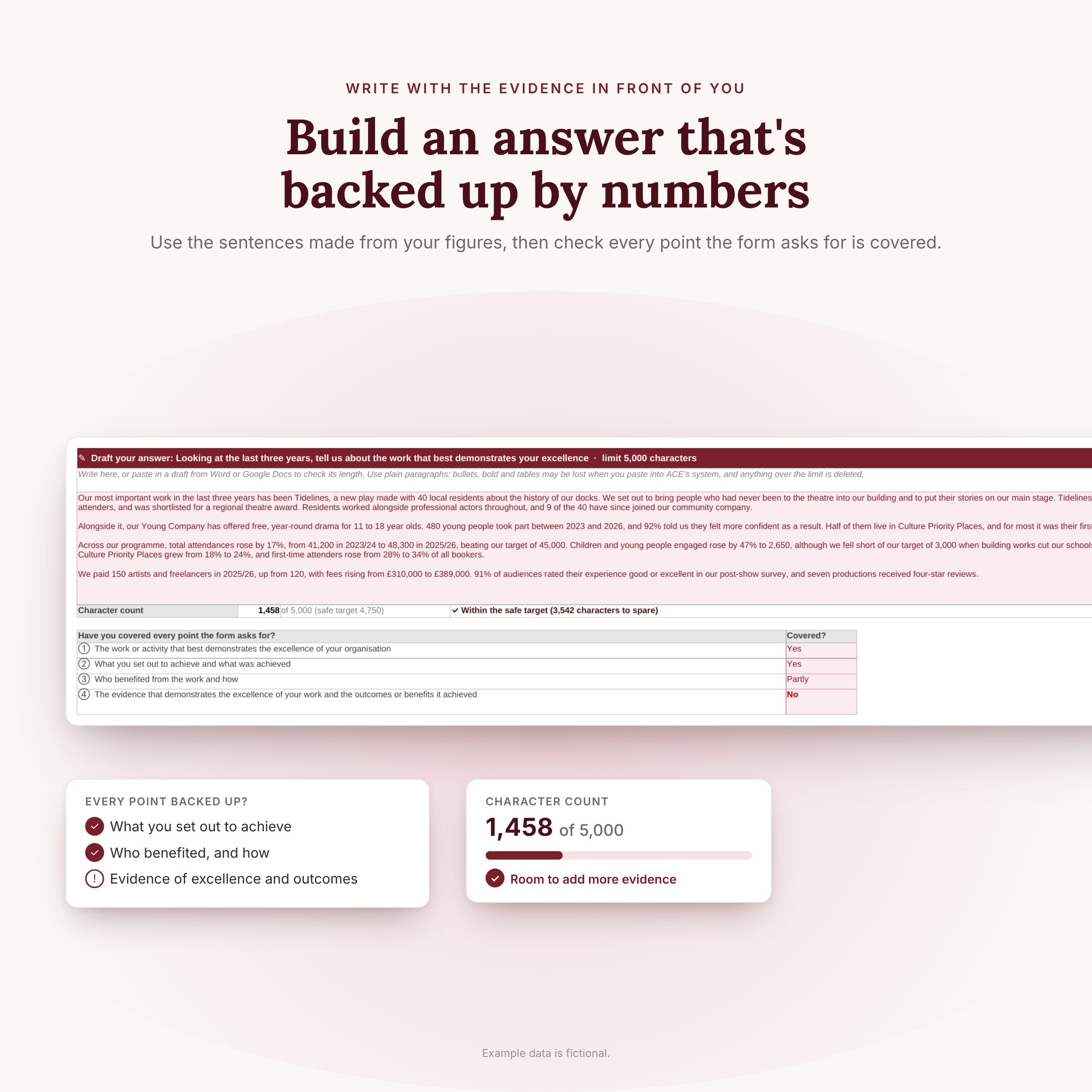
Write and check. Sentences built from your figures appear as you type. Draft your full answer in the workbook, check it against the character limit, and tick off every point the question asks you to cover.
What's inside
10 question pages:
PW1 Your best work
PW2 How you've developed
PR1 Your plans
PR2 Who it's for
PR3 Your development
GOV1 Governance
GOV2 Risks
DEM Leadership data
ADD Extra investment
FIN Finances
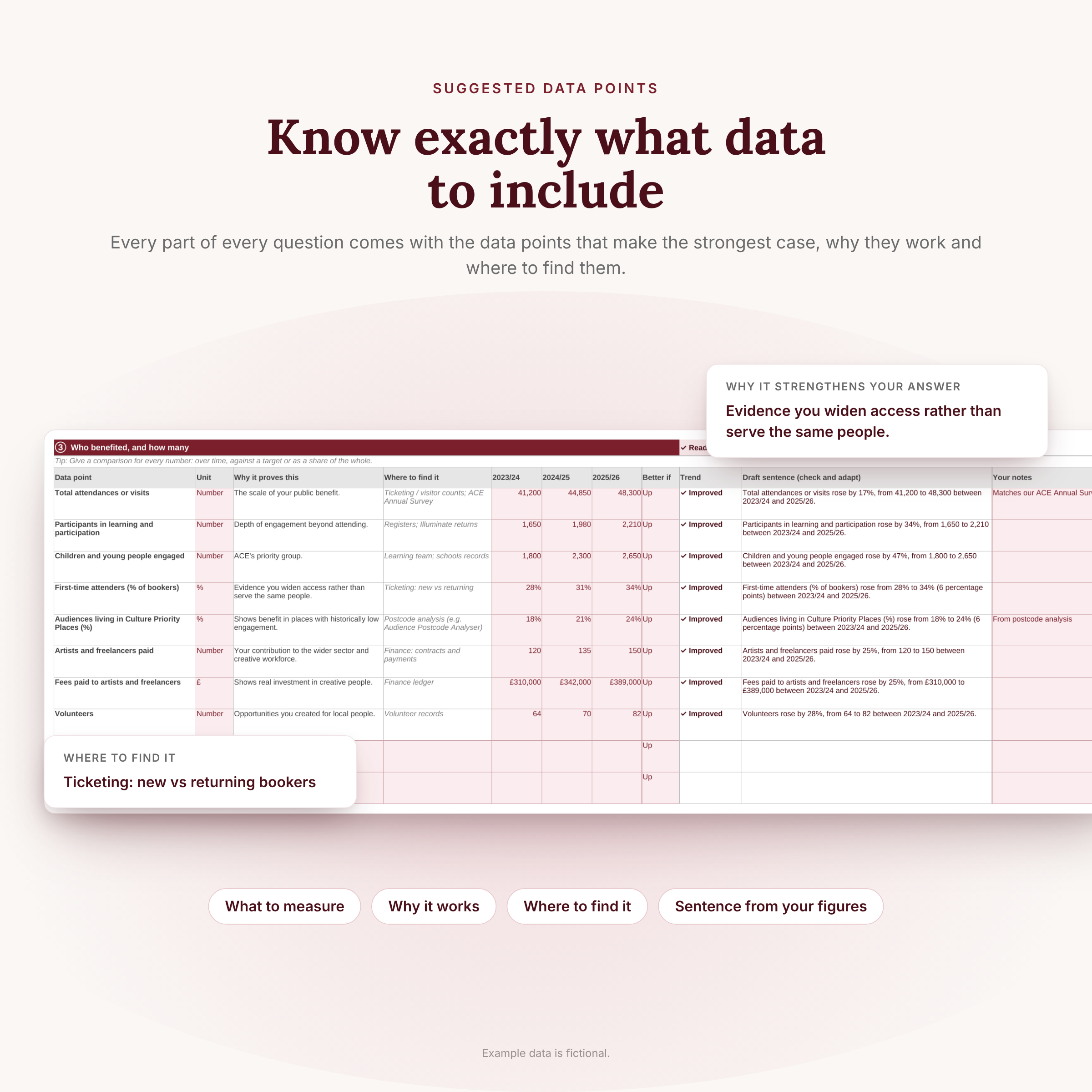
Over 100 suggested data points, each with why it strengthens your answer and where to find it
Sentences written from your numbers, such as "Total attendances rose by 17%, from 41,200 to 48,300 between 2023/24 and 2025/26"
A draft box for every written answer, with a live character count and a safe target set at 95% of the limit
"Every point covered?" checklists, so no part of a question is missed
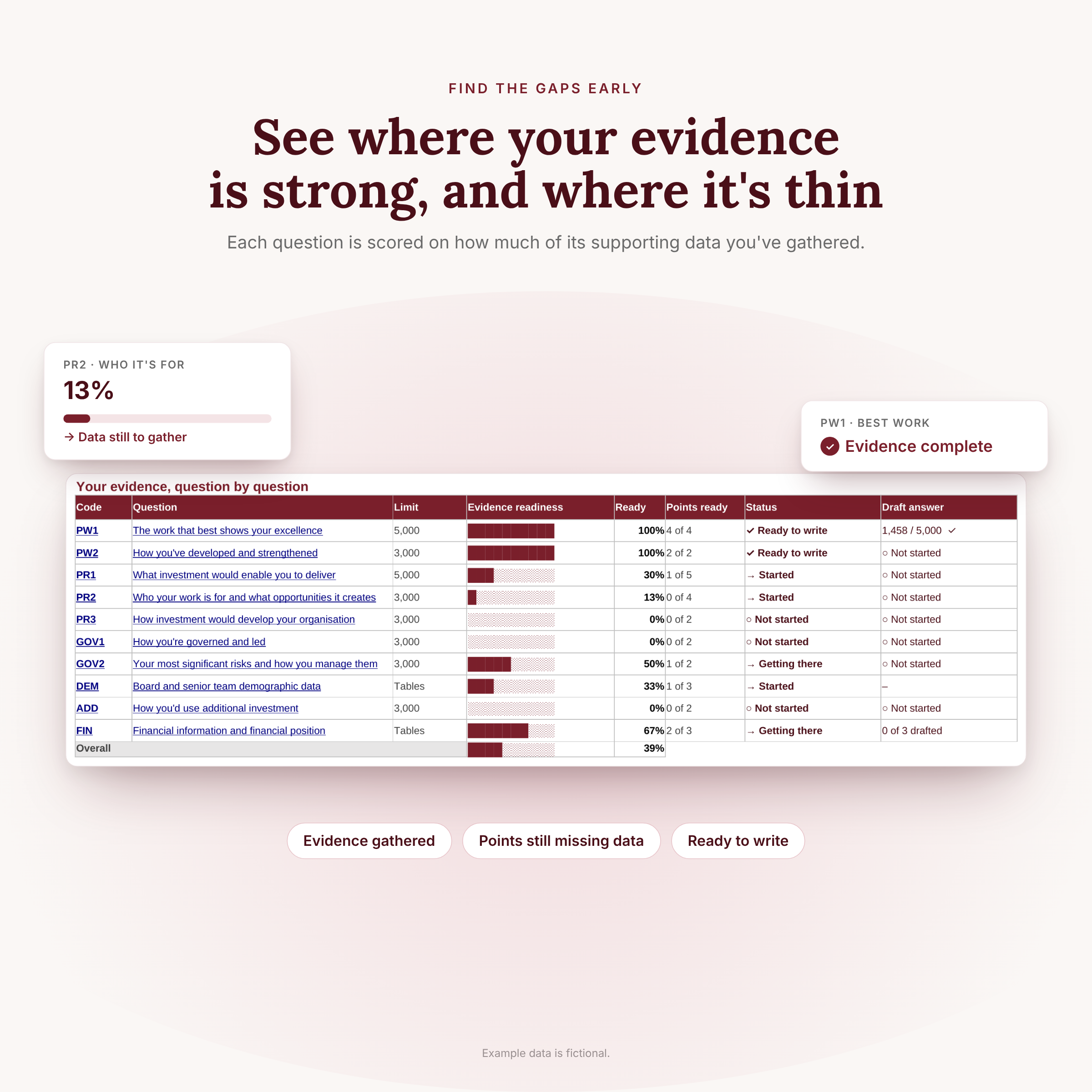
An evidence readiness dashboard showing where your evidence is strong and where it's thin
Finance checks:
flags any income or spending change over 20% that you'll need to explain
works out your key ratios
stress-tests your income
Built-in error checks that warn you about typos such as "TBC" in a figure cell, a percentage typed as 34 instead of 34%, or a negative count
Notes on every table and page, plus a team to-do list for sharing out the evidence-gathering
Who it's for
Arts and cultural organisations applying to the 2028–33 round, whether you're already funded or applying for the first time
Directors, fundraisers, bid writers and the consultants who support them
Format
Microsoft Excel workbook (.xlsx) for Windows or Mac; also opens in Google Sheets
Instant download, no macros
Key dates: applications open on 20 October 2026 and close at 12:00 midday on 15 December 2026.
This is an independent resource. It is not affiliated with or endorsed by Arts Council England. It helps you organise and present your evidence. It does not write your application or guarantee funding. Always check Arts Council England's current guidance.
Questions? Email info@theartsanalyst.com
FAQ
What data should I include in my NPO 2028–33 application?
Choose figures that prove each point the question asks for. Good examples are audience and participant numbers over time, first-time attenders, reach in Culture Priority Places, quality ratings, and artists and freelancers paid. Comparisons over time, against a target or as a share of the whole make the strongest evidence. The workbook suggests over 100 data points, matched to each question.
Can I use charts or tables in my NPO application?
No. The written answers are typed text with character limits, and formatting such as bullets, bold and tables may be lost when you paste into Arts Council England's system. That's why this workbook turns your data into written sentences you can paste straight in.
How do I evidence excellence for Arts Council England?
Name one or two flagship pieces of work. Then back them up with specific figures: what you set out to achieve against what you achieved, who benefited, and independent evidence such as audience ratings, reviews or awards. The PW1 page takes you through this step by step.
I'm applying for the first time. Is this for me?
Yes. It works for current National Portfolio Organisations and first-time applicants alike. Leave blank any rows that don't apply. You only need one or two strong data points for each part of a question.
What if I don't have all the data?
Each data point comes with suggestions of where to find it, including free public data. The readiness dashboard shows which questions still need evidence, so you can prioritise before the deadline.
Does it work in Google Sheets?
It's designed for Microsoft Excel on Windows or Mac and also opens in Google Sheets.
Is this an official Arts Council England resource?
No. It's an independent resource created by The Arts Analyst, a data analysis consultancy for arts and culture organisations. Always check Arts Council England's current guidance and application form.
Back up every answer in your National Portfolio application with data.
The Arts Council England National Portfolio 2028–33 application asks you to prove your case in writing. You can't add charts, and every answer has a strict character limit. Most organisations already have the evidence. The hard part is knowing which figures prove which point, and getting them into a strong answer before the deadline.
This Excel workbook goes through the application one question at a time. It suggests the data points that strengthen each answer, explains why each one works and where to find it, then turns your figures into sentences you can use.
How it works
Pick a question. Each page starts with exactly what the form asks, split into numbered points.
Add your figures. Under each point you'll find the data that makes the strongest case, why it works, and where to find it: ticketing, finance, surveys or free public data.
Write and check. Sentences built from your figures appear as you type. Draft your full answer in the workbook, check it against the character limit, and tick off every point the question asks you to cover.
What's inside
10 question pages:
PW1 Your best work
PW2 How you've developed
PR1 Your plans
PR2 Who it's for
PR3 Your development
GOV1 Governance
GOV2 Risks
DEM Leadership data
ADD Extra investment
FIN Finances
Over 100 suggested data points, each with why it strengthens your answer and where to find it
Sentences written from your numbers, such as "Total attendances rose by 17%, from 41,200 to 48,300 between 2023/24 and 2025/26"
A draft box for every written answer, with a live character count and a safe target set at 95% of the limit
"Every point covered?" checklists, so no part of a question is missed
An evidence readiness dashboard showing where your evidence is strong and where it's thin
Finance checks:
flags any income or spending change over 20% that you'll need to explain
works out your key ratios
stress-tests your income
Built-in error checks that warn you about typos such as "TBC" in a figure cell, a percentage typed as 34 instead of 34%, or a negative count
Notes on every table and page, plus a team to-do list for sharing out the evidence-gathering
Who it's for
Arts and cultural organisations applying to the 2028–33 round, whether you're already funded or applying for the first time
Directors, fundraisers, bid writers and the consultants who support them
Format
Microsoft Excel workbook (.xlsx) for Windows or Mac; also opens in Google Sheets
Instant download, no macros
Key dates: applications open on 20 October 2026 and close at 12:00 midday on 15 December 2026.
This is an independent resource. It is not affiliated with or endorsed by Arts Council England. It helps you organise and present your evidence. It does not write your application or guarantee funding. Always check Arts Council England's current guidance.
Questions? Email info@theartsanalyst.com
FAQ
What data should I include in my NPO 2028–33 application?
Choose figures that prove each point the question asks for. Good examples are audience and participant numbers over time, first-time attenders, reach in Culture Priority Places, quality ratings, and artists and freelancers paid. Comparisons over time, against a target or as a share of the whole make the strongest evidence. The workbook suggests over 100 data points, matched to each question.
Can I use charts or tables in my NPO application?
No. The written answers are typed text with character limits, and formatting such as bullets, bold and tables may be lost when you paste into Arts Council England's system. That's why this workbook turns your data into written sentences you can paste straight in.
How do I evidence excellence for Arts Council England?
Name one or two flagship pieces of work. Then back them up with specific figures: what you set out to achieve against what you achieved, who benefited, and independent evidence such as audience ratings, reviews or awards. The PW1 page takes you through this step by step.
I'm applying for the first time. Is this for me?
Yes. It works for current National Portfolio Organisations and first-time applicants alike. Leave blank any rows that don't apply. You only need one or two strong data points for each part of a question.
What if I don't have all the data?
Each data point comes with suggestions of where to find it, including free public data. The readiness dashboard shows which questions still need evidence, so you can prioritise before the deadline.
Does it work in Google Sheets?
It's designed for Microsoft Excel on Windows or Mac and also opens in Google Sheets.
Is this an official Arts Council England resource?
No. It's an independent resource created by The Arts Analyst, a data analysis consultancy for arts and culture organisations. Always check Arts Council England's current guidance and application form.